Decision page
Catalog enrichment stack for Ecommerce
What should an ecommerce team use to enrich product titles, attributes and descriptions at scale?
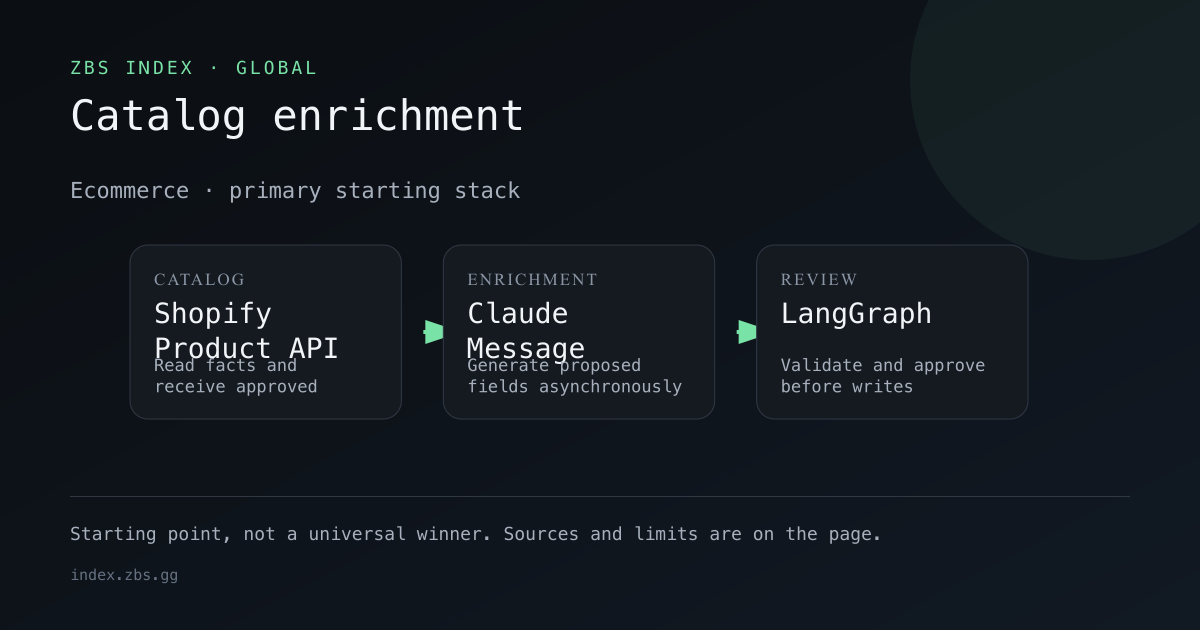
ZBS editorial starting point. Start with Shopify Product API as the fact boundary, Claude Message Batches for enrichment and LangGraph for approval.
Merchants receive proposed changes in bulk while source attributes and publication authority stay outside the model.
Editorial starting point
Batch enrichment with approval
A concrete starting configuration that keeps source facts, model output and operational authority separate.
Choose this when: The catalog is large and changes can be reviewed in batches.
-
Read facts and receive approved updates. The official product object remains the boundary for current catalog facts.
Limit: Generated text must never silently overwrite source attributes or unsupported claims.
Evidence: source 1
-
Generate proposed fields asynchronously. The official batch API is designed for high-volume work that does not need an immediate response.
Limit: Completion, expiry, result retention and review still need an explicit operating path.
Evidence: source 1
-
Validate and approve before writes. Stateful workflow steps keep model output separate from acceptance and operational action.
Limit: Policy, persistence, access control and recovery remain application responsibilities.
Evidence: source 1
Private / local
Controlled reasoning path
Keep parsing, retrieval or model inference in controlled infrastructure while retaining the same source-of-truth and approval rules.
Choose this when: Sensitive inputs cannot be sent to an external model API and the team can operate the additional infrastructure.
-
Supply authoritative fields. The official product object remains the boundary for current catalog facts.
Limit: Generated text must never silently overwrite source attributes or unsupported claims.
Evidence: source 1
-
Enrichment
vLLM
source backed inference
Serve a local enrichment model. It provides a documented self-operated model-serving layer.
Limit: Serving a model does not prove its task accuracy, safe tool use or secure operation.
Evidence: source 1
-
Run validation and approval. Stateful workflow steps keep model output separate from acceptance and operational action.
Limit: Policy, persistence, access control and recovery remain application responsibilities.
Evidence: source 1
Budget alternative
Lower-cost external model path
Keep the workflow and source integration explicit while evaluating a lower-cost model candidate on the same acceptance set.
Choose this when: External processing is acceptable and measured model spend is a leading constraint.
-
Provide the same source catalog. The official product object remains the boundary for current catalog facts.
Limit: Generated text must never silently overwrite source attributes or unsupported claims.
Evidence: source 1
-
Produce candidate catalog fields. It is a concrete lower-cost external model candidate for the same acceptance set.
Limit: Price alone is not task fitness; output structure, languages, availability and data terms need testing.
Evidence: source 1
-
Apply the same safety gate. Stateful workflow steps keep model output separate from acceptance and operational action.
Limit: Policy, persistence, access control and recovery remain application responsibilities.
Evidence: source 1
Trade-offs that change the choice
Implementation path
1. Separate immutable source attributes from editable fields.
2. Create accepted and rejected brand examples.
3. Diff proposals and block unsupported claims.
4. Measure acceptance, factual errors and review time.
Known limits
Generated copy cannot introduce unsupported certifications.
Batch savings do not remove review cost.
No product on this page is a universal winner; the configuration still needs a task-specific acceptance test.
EU and US routes stay consolidated with Global until evidence changes the answer.
Every component as data
The components in this stack are catalog entries. Fetch them with their versions, repository status and observation dates instead of reading this page.
GET /api/v1/catalog.json