Decision page
Customer support agent stack for Ecommerce
What should an ecommerce team use for a customer support agent that can answer and safely act on orders?
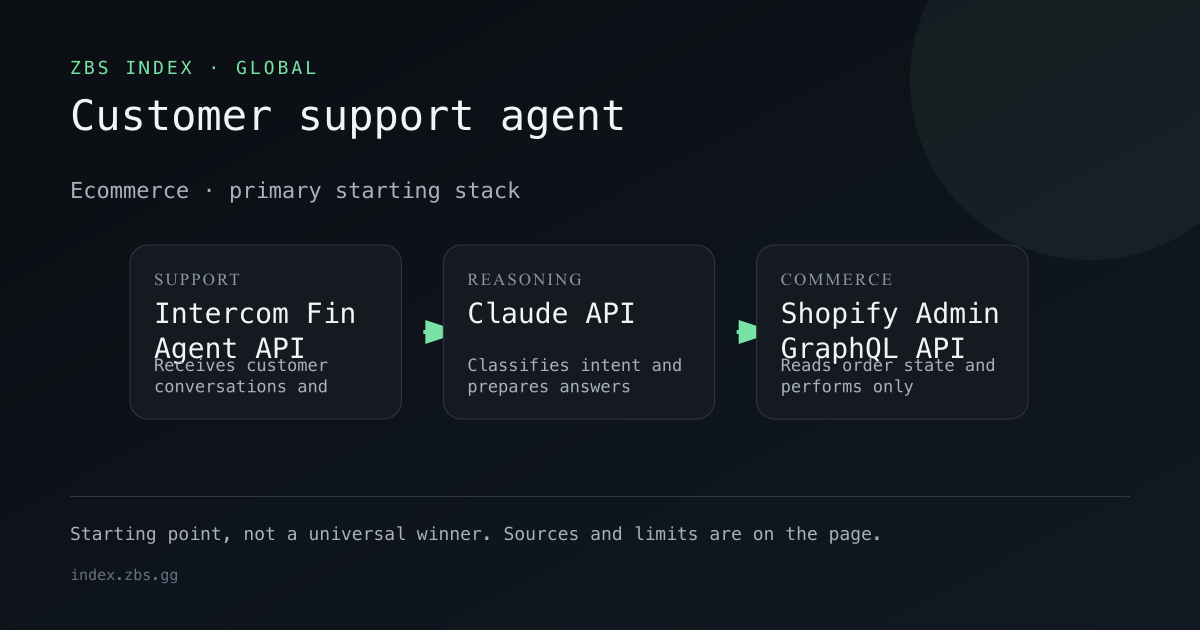
ZBS editorial starting point. Start with Intercom Fin Agent API for the support channel, Claude API for bounded reasoning and Shopify Admin GraphQL for approved order actions; make all refunds and account changes policy-gated.
Customers get faster order answers, while refunds, identity-sensitive changes and uncertain cases remain under explicit policy and human control.
Editorial starting point
Managed support with bounded actions
Use an existing support-agent surface and keep order actions in a separate allowlisted integration.
Choose this when: The team needs a fast support-channel launch and accepts external processing.
-
Receives customer conversations and returns agent answers through the support channel. Intercom documents an API path for integrating Fin into an existing helpdesk or messenger
Limit: The API requires approved access and current documentation describes parts of the orchestration surface as preview
Evidence: source 1
-
Classifies intent and prepares answers within the store policy. It is a practical external reasoning layer with documented API and residency choices
Limit: Do not imply EU inference residency; current first-party documentation lists US and Global inference geography
Evidence: source 1, source 2
-
Reads order state and performs only approved commerce actions. The official API exposes typed commerce data and mutations that can be allowlisted separately from conversation logic
Limit: Permissions and business policy must prevent the agent from issuing arbitrary refunds or changing sensitive account data
Evidence: source 1
Private / local
Controlled reasoning path
Operate the reasoning layer yourself while keeping commerce actions explicitly constrained.
Choose this when: Conversation data cannot be sent to an external model API and the team accepts a custom support surface.
-
Runs support state, tool calls and approval checkpoints. Its stateful workflow model can keep order actions separate from answer generation
Limit: You must build the support-channel integration, persistence and incident handling
Evidence: source 1
-
Reasoning
vLLM
source backed inference
Serves a selected local model behind the support workflow. It provides a documented self-hosted model API layer
Limit: Local serving does not guarantee answer quality, language coverage or safe tool use
Evidence: source 1
-
Reads and updates only allowlisted order fields. The commerce boundary stays the same regardless of model hosting
Limit: API scopes and workflow policy require separate review and testing
Evidence: source 1
Budget alternative
Custom lower-cost API path
Build a small workflow with a lower-cost model candidate while retaining strict commerce-tool boundaries.
Choose this when: The team can own the support workflow and external processing is acceptable.
-
Coordinates retrieval, answer generation and approved actions. It keeps the workflow independent of the chosen model API
Limit: A custom workflow carries more maintenance than a managed support product
Evidence: source 1
-
Generates bounded support answers and tool arguments. It is a candidate for a lower-cost external model comparison
Limit: Verify multilingual support, policy adherence, availability and data terms; API price is only one part of cost
Evidence: source 1
-
Provides the order data and approved mutations. The official commerce API remains the source of truth rather than model memory
Limit: Refunds and identity-sensitive changes still need deterministic rules or human approval
Evidence: source 1
Trade-offs that change the choice
Implementation path
1. Start with read-only order status, delivery questions and policy retrieval.
2. Define allowlisted actions and require human approval for refunds, address changes and identity-sensitive requests.
3. Test prompt injection, cross-customer data leakage, wrong-order selection and ambiguous return policies.
4. Measure resolution rate, escalation accuracy, wrong actions, support time and total cost before enabling another action.
Known limits
The Fin Agent API currently has access and version prerequisites, so availability must be confirmed for the target account.
A model answer cannot be the order system of record; live commerce data must come from the store API.
Regional consumer, privacy and refund requirements need reviewed regional differences before a separate URL is indexed.
Every component as data
The components in this stack are catalog entries. Fetch them with their versions, repository status and observation dates instead of reading this page.
GET /api/v1/catalog.json