Decision page
Review analysis stack for Ecommerce
What should an ecommerce team use to turn product reviews into an evidence-backed issue list?
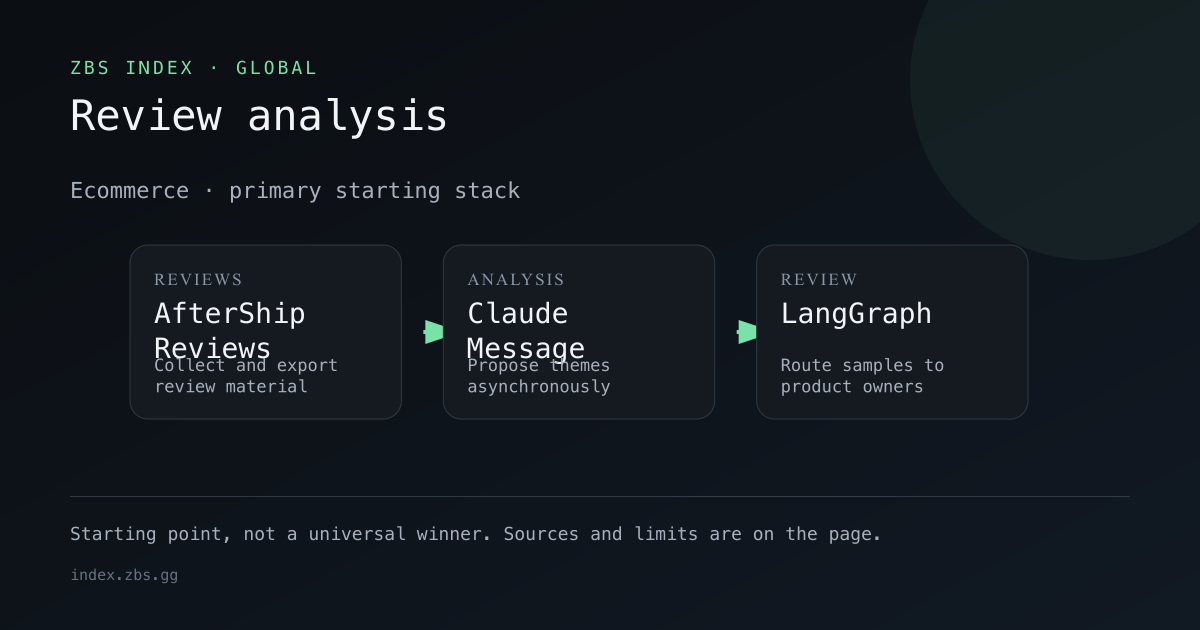
ZBS editorial starting point. Start with AfterShip Reviews for the corpus, Claude Message Batches for themes and LangGraph for sampling and approval.
Product teams receive themes linked to source reviews instead of an unsupported sentiment summary.
Editorial starting point
Batch review analysis with source samples
A concrete starting configuration that keeps source facts, model output and operational authority separate.
Choose this when: The corpus is large and owners can validate themes against sampled source text.
-
Collect and export review material. The official help center documents review collection, management and historical export.
Limit: Coverage, verification state and export fields need checking for the actual store.
Evidence: source 1
-
Propose themes asynchronously. The official batch API is designed for high-volume work that does not need an immediate response.
Limit: Completion, expiry, result retention and review still need an explicit operating path.
Evidence: source 1
-
Route samples to product owners. Stateful workflow steps keep model output separate from acceptance and operational action.
Limit: Policy, persistence, access control and recovery remain application responsibilities.
Evidence: source 1
Private / local
Controlled reasoning path
Keep parsing, retrieval or model inference in controlled infrastructure while retaining the same source-of-truth and approval rules.
Choose this when: Sensitive inputs cannot be sent to an external model API and the team can operate the additional infrastructure.
-
Export the source corpus. The official help center documents review collection, management and historical export.
Limit: Coverage, verification state and export fields need checking for the actual store.
Evidence: source 1
-
Retrieval
pgvector
source backed inference
Retrieve representative examples. It keeps vector search beside relational metadata and access filters in PostgreSQL.
Limit: Approximate retrieval can miss results and needs recall measurement against an exact baseline.
Evidence: source 1
-
Analysis
vLLM
source backed inference
Serve a local theme model. It provides a documented self-operated model-serving layer.
Limit: Serving a model does not prove its task accuracy, safe tool use or secure operation.
Evidence: source 1
-
Require owner acceptance. Stateful workflow steps keep model output separate from acceptance and operational action.
Limit: Policy, persistence, access control and recovery remain application responsibilities.
Evidence: source 1
Budget alternative
Lower-cost external model path
Keep the workflow and source integration explicit while evaluating a lower-cost model candidate on the same acceptance set.
Choose this when: External processing is acceptable and measured model spend is a leading constraint.
-
Supply the same corpus. The official help center documents review collection, management and historical export.
Limit: Coverage, verification state and export fields need checking for the actual store.
Evidence: source 1
-
Produce candidate themes. It is a concrete lower-cost external model candidate for the same acceptance set.
Limit: Price alone is not task fitness; output structure, languages, availability and data terms need testing.
Evidence: source 1
-
Run sampling and approval. Stateful workflow steps keep model output separate from acceptance and operational action.
Limit: Policy, persistence, access control and recovery remain application responsibilities.
Evidence: source 1
Trade-offs that change the choice
Implementation path
1. Freeze a dated export with product and language.
2. Require positive and negative source examples.
3. Blind-review rare and severe themes.
4. Measure precision, missed issues and analyst time.
Known limits
Reviews are reports, not controlled tests.
Volume is not automatically severity or revenue impact.
No product on this page is a universal winner; the configuration still needs a task-specific acceptance test.
EU and US routes stay consolidated with Global until evidence changes the answer.
Every component as data
The components in this stack are catalog entries. Fetch them with their versions, repository status and observation dates instead of reading this page.
GET /api/v1/catalog.json