Decision page
Voice sales agent stack for Ecommerce
What should an ecommerce team use for a voice sales agent connected to live product data?
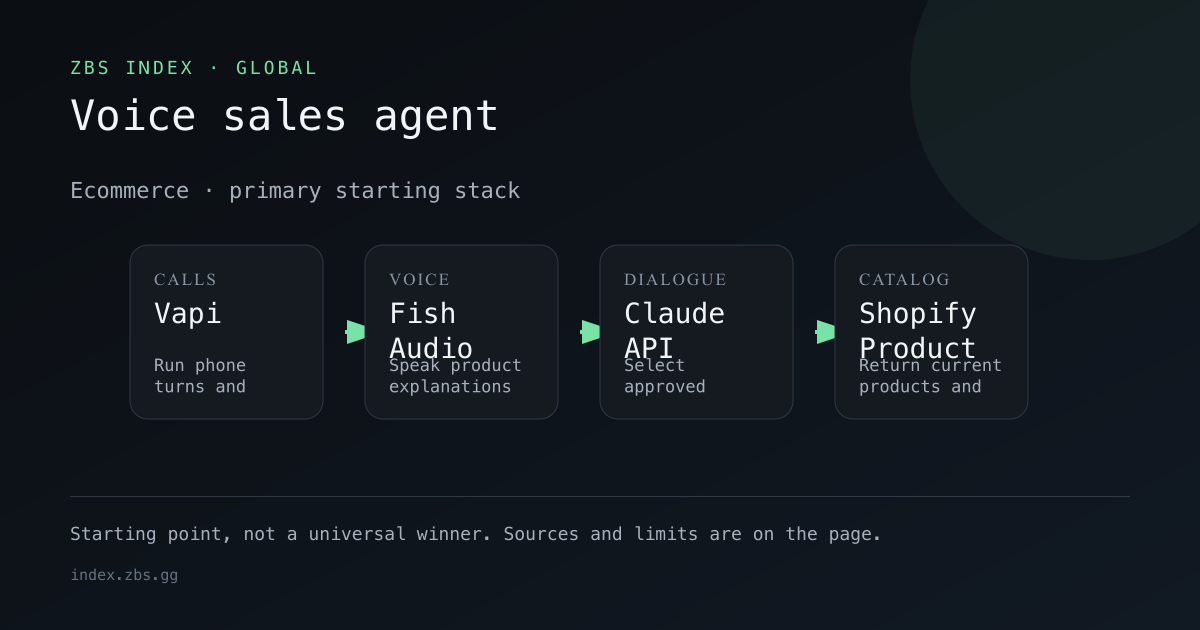
ZBS editorial starting point. Start with Vapi for calls, Fish Audio for voice, Claude API for bounded dialogue and Shopify Product API for live facts.
Callers discover products from current data while price, inventory and checkout remain in Shopify.
Editorial starting point
Managed voice sales over live catalog data
A concrete starting configuration that keeps source facts, model output and operational authority separate.
Choose this when: The store needs a quick phone prototype and accepts external voice and model processing.
-
Run phone turns and tools. The official documentation exposes a provider-composition path for phone agents.
Limit: Recording, retention, telephony and every configured provider remain separate boundaries.
Evidence: source 1
-
Speak product explanations. The speech API can be evaluated and replaced independently of the rest of the agent.
Limit: Pronunciation, language quality, latency and full-call cost require direct measurement.
Evidence: source 1
-
Select approved catalog queries. The external API is a practical bounded reasoning layer with documented behavior.
Limit: The model must not replace source-of-truth data, deterministic policy or human authority.
Evidence: source 1
-
Return current products and variants. The official product object remains the boundary for current catalog facts.
Limit: Generated text must never silently overwrite source attributes or unsupported claims.
Evidence: source 1
Private / local
Controlled reasoning path
Keep parsing, retrieval or model inference in controlled infrastructure while retaining the same source-of-truth and approval rules.
Choose this when: Sensitive inputs cannot be sent to an external model API and the team can operate the additional infrastructure.
-
Run the realtime workflow. The framework documents a provider-flexible realtime agent runtime.
Limit: Self-operation transfers telephony, scaling and recovery work to the team.
Evidence: source 1
-
Transcribe callers locally. It provides an open speech-recognition path that can run in controlled infrastructure.
Limit: Phone audio, accents, names and realtime performance require direct testing.
Evidence: source 1
-
Dialogue
vLLM
source backed inference
Serve a local sales model. It provides a documented self-operated model-serving layer.
Limit: Serving a model does not prove its task accuracy, safe tool use or secure operation.
Evidence: source 1
-
Provide current catalog facts. The official product object remains the boundary for current catalog facts.
Limit: Generated text must never silently overwrite source attributes or unsupported claims.
Evidence: source 1
Budget alternative
Lower-cost external model path
Keep the workflow and source integration explicit while evaluating a lower-cost model candidate on the same acceptance set.
Choose this when: External processing is acceptable and measured model spend is a leading constraint.
-
Calls
Vapi
source backed inference
Keep call orchestration managed. The official documentation exposes a provider-composition path for phone agents.
Limit: Recording, retention, telephony and every configured provider remain separate boundaries.
Evidence: source 1
-
Produce bounded tool calls. It is a concrete lower-cost external model candidate for the same acceptance set.
Limit: Price alone is not task fitness; output structure, languages, availability and data terms need testing.
Evidence: source 1
-
Stream spoken answers. The speech API can be evaluated and replaced independently of the rest of the agent.
Limit: Pronunciation, language quality, latency and full-call cost require direct measurement.
Evidence: source 1
-
Return live catalog facts. The official product object remains the boundary for current catalog facts.
Limit: Generated text must never silently overwrite source attributes or unsupported claims.
Evidence: source 1
Trade-offs that change the choice
Implementation path
1. Start with read-only discovery and allowed claims.
2. Test stock changes, ambiguous products and prompt injection.
3. Send checkout to an approved link or human.
4. Measure match quality, invented claims and revenue per call.
Known limits
A conversational recommendation does not prove suitability.
Payments and binding offers need separate controls.
No product on this page is a universal winner; the configuration still needs a task-specific acceptance test.
EU and US routes stay consolidated with Global until evidence changes the answer.
Every component as data
The components in this stack are catalog entries. Fetch them with their versions, repository status and observation dates instead of reading this page.
GET /api/v1/catalog.json