Decision page
Contract review and redlining stack for Legal
What should a legal team use for a first-pass contract review and redlining workflow?
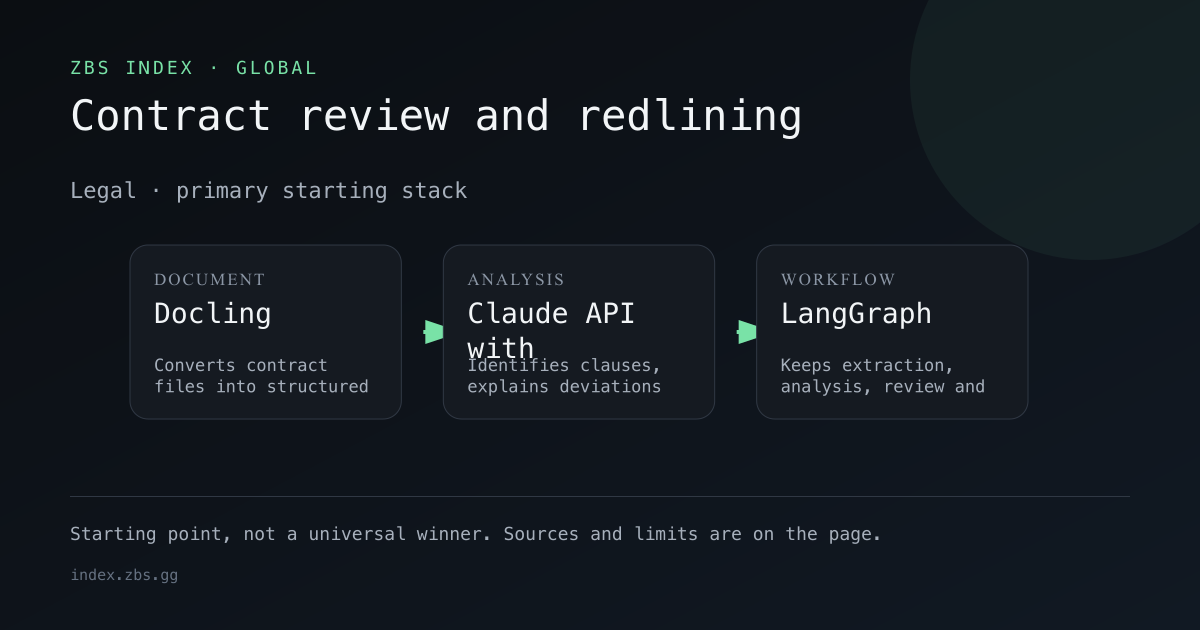
ZBS editorial starting point. Start with Docling for document conversion, Claude API for clause analysis with citations and LangGraph for a reviewable workflow; keep every proposed change behind a lawyer approval step.
Reviewers receive a structured first pass with cited source passages, deviations and proposed edits instead of an untraceable summary.
Editorial starting point
Cited managed review
A managed reasoning path with source citations and an explicit approval workflow.
Choose this when: Traceability and time to a useful first pass matter more than local inference.
-
Converts contract files into structured text for downstream review. Its public quickstart documents conversion and structured export paths
Limit: Complex layouts, scans and annotations still need a representative parsing test
Evidence: source 1
-
Identifies clauses, explains deviations and attaches source passages. Anthropic documents native citation handling for supported models and document inputs
Limit: Citations improve traceability but do not make the legal conclusion correct; residency options also require separate checking
Evidence: source 1, source 2
-
Keeps extraction, analysis, review and approval as inspectable steps. The framework is designed for stateful workflows and human-in-the-loop agent control
Limit: A workflow framework does not supply legal policy or evaluation data
Evidence: source 1
Private / local
Controlled document review
Keep parsing and inference in controlled infrastructure while retaining the same lawyer approval gate.
Choose this when: Contracts cannot be sent to an external model API and the team can operate model serving.
-
Document
Docling
source backed inference
Converts contracts locally into structured text. The conversion path can run in the controlled environment
Limit: Parsing quality must be tested across the firm’s document set
Evidence: source 1
-
Analysis
vLLM
source backed inference
Serves the selected local language model behind an API. It provides a documented self-hosted serving layer for a controlled workflow
Limit: The serving layer says nothing about legal accuracy, context length or citation fidelity of the chosen model
Evidence: source 1
-
Runs review checkpoints and lawyer approval. The same explicit workflow can be used without an external model provider
Limit: The team owns persistence, access control and operational recovery
Evidence: source 1
Budget alternative
Lower-cost external analysis
Retain deterministic document conversion and workflow controls while evaluating a lower-cost model API.
Choose this when: External processing is acceptable and model spend is a material constraint.
-
Document
Docling
source backed inference
Converts contracts to structured inputs. The parsing layer remains independent of the model choice
Limit: Scanned and heavily formatted contracts can require OCR and layout tuning
Evidence: source 1
-
Produces clause analysis and structured proposed changes. It is a candidate external API for a cost-sensitive comparison
Limit: Do not assume citation fidelity or legal fitness from API compatibility; test exact source-grounding behavior
Evidence: source 1
-
Enforces review stages and final human approval. Keeping orchestration explicit reduces dependence on one model API
Limit: Evaluation, policy and access controls remain application responsibilities
Evidence: source 1
Trade-offs that change the choice
Implementation path
1. Define the clause playbook and permitted redline actions before connecting a model.
2. Create a representative evaluation set with accepted and rejected edits from lawyers.
3. Require source passage, confidence note and approval status for every proposed change.
4. Measure missed clauses, unsupported claims, citation correctness and reviewer time before expanding document types.
Known limits
This is a workflow recommendation, not legal advice and not evidence that any model is competent on a particular jurisdiction.
Native citations identify source text; they do not validate the legal interpretation.
Regional legal and data-residency differences require their own reviewed page rather than a renamed Global page.
Every component as data
The components in this stack are catalog entries. Fetch them with their versions, repository status and observation dates instead of reading this page.
GET /api/v1/catalog.json