Decision page
Delivery exception triage stack for Logistics
What should a logistics team use to classify delivery exceptions and route the next action?
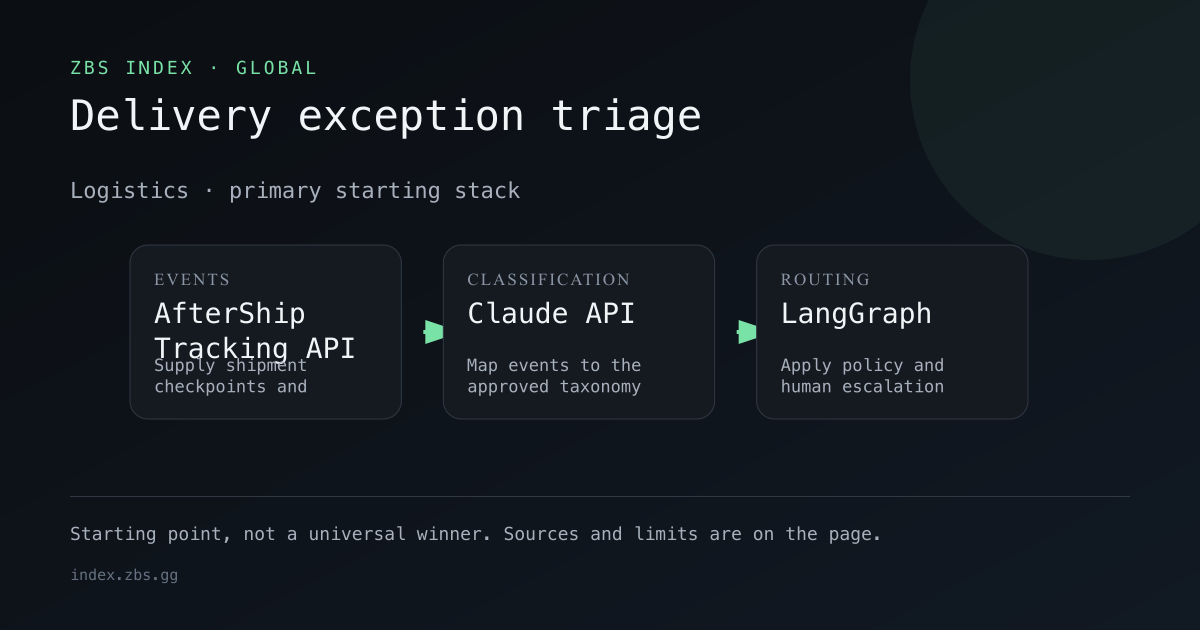
ZBS editorial starting point. Start with AfterShip Tracking API for normalized events, Claude API for bounded classification and LangGraph for policy-based routing.
Exceptions are assigned faster while shipment state stays anchored in a live tracking system.
Editorial starting point
Event-driven exception triage
A concrete starting configuration that keeps source facts, model output and operational authority separate.
Choose this when: The operation spans multiple carriers and needs auditable escalation.
-
Supply shipment checkpoints and exception states. The official API documents carrier-normalized tracking records, updates and webhooks.
Limit: Carrier coverage, plan access, rate limits and event quality require direct checking.
Evidence: source 1
-
Map events to the approved taxonomy. The external API is a practical bounded reasoning layer with documented behavior.
Limit: The model must not replace source-of-truth data, deterministic policy or human authority.
Evidence: source 1
-
Apply policy and human escalation. Stateful workflow steps keep model output separate from acceptance and operational action.
Limit: Policy, persistence, access control and recovery remain application responsibilities.
Evidence: source 1
Private / local
Controlled reasoning path
Keep parsing, retrieval or model inference in controlled infrastructure while retaining the same source-of-truth and approval rules.
Choose this when: Sensitive inputs cannot be sent to an external model API and the team can operate the additional infrastructure.
-
Supply external carrier facts. The official API documents carrier-normalized tracking records, updates and webhooks.
Limit: Carrier coverage, plan access, rate limits and event quality require direct checking.
Evidence: source 1
-
Classification
vLLM
source backed inference
Serve a local classifier. It provides a documented self-operated model-serving layer.
Limit: Serving a model does not prove its task accuracy, safe tool use or secure operation.
Evidence: source 1
-
Run deterministic escalation. Stateful workflow steps keep model output separate from acceptance and operational action.
Limit: Policy, persistence, access control and recovery remain application responsibilities.
Evidence: source 1
Budget alternative
Lower-cost external model path
Keep the workflow and source integration explicit while evaluating a lower-cost model candidate on the same acceptance set.
Choose this when: External processing is acceptable and measured model spend is a leading constraint.
-
Keep the event input fixed. The official API documents carrier-normalized tracking records, updates and webhooks.
Limit: Carrier coverage, plan access, rate limits and event quality require direct checking.
Evidence: source 1
-
Produce candidate exception labels. It is a concrete lower-cost external model candidate for the same acceptance set.
Limit: Price alone is not task fitness; output structure, languages, availability and data terms need testing.
Evidence: source 1
-
Apply the same policy. Stateful workflow steps keep model output separate from acceptance and operational action.
Limit: Policy, persistence, access control and recovery remain application responsibilities.
Evidence: source 1
Trade-offs that change the choice
Implementation path
1. Define categories, owners and forbidden actions.
2. Replay historical events without changing shipments.
3. Review label disagreements and severe exceptions.
4. Measure wrong routing, missed severity and time to owner.
Known limits
Carrier events can be late, incomplete or wrong.
The model cannot promise dates or compensation.
No product on this page is a universal winner; the configuration still needs a task-specific acceptance test.
EU and US routes stay consolidated with Global until evidence changes the answer.
Every component as data
The components in this stack are catalog entries. Fetch them with their versions, repository status and observation dates instead of reading this page.
GET /api/v1/catalog.json