Decision page
Voice dispatcher stack for Logistics
What should a logistics team use to build a voice dispatcher for shipment calls?
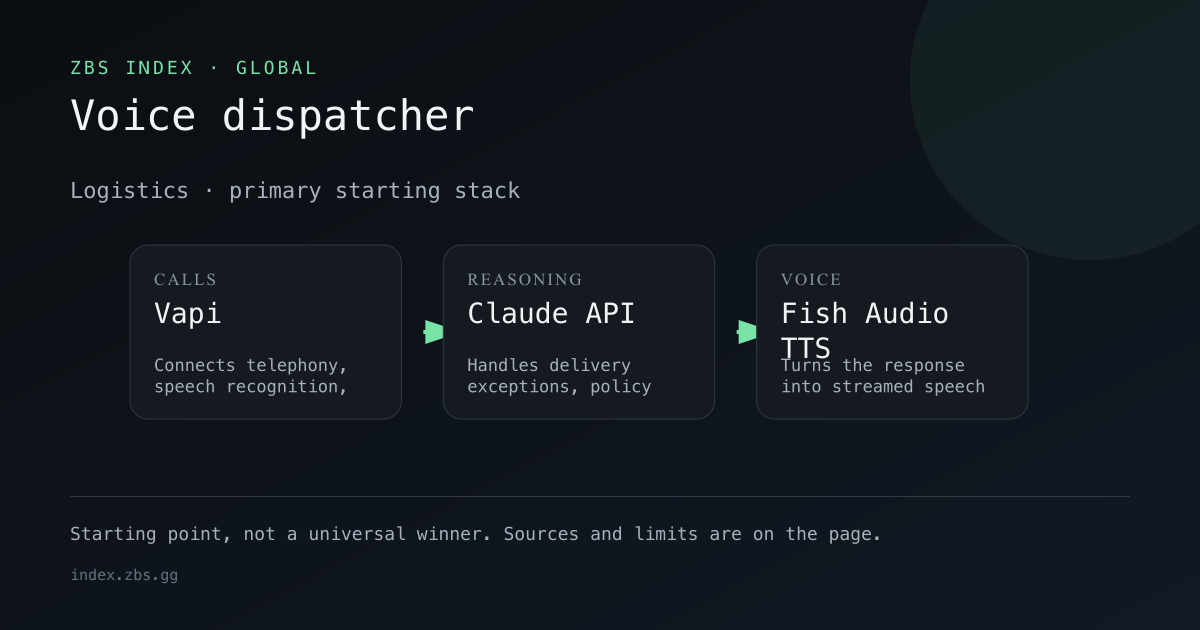
ZBS editorial starting point. Start with Vapi for call orchestration, Claude API for exception reasoning and Fish Audio for speech output; validate latency, languages and data handling on real call recordings before production.
Routine shipment-status and routing calls can be answered consistently, while uncertain or policy-sensitive cases are handed to a human dispatcher.
Editorial starting point
Managed voice workflow
A quick route to a working phone agent while keeping the model and voice providers replaceable.
Choose this when: Time to first reliable call matters more than owning every runtime component.
-
Connects telephony, speech recognition, model calls and speech output. Its public documentation exposes the provider composition and phone-agent path needed for a fast first implementation
Limit: Review recording storage and every configured provider separately; a managed orchestrator is not one privacy boundary
Evidence: source 1, source 2
-
Handles delivery exceptions, policy questions and structured hand-off decisions. The API is a practical external reasoning layer and its current residency options are documented explicitly
Limit: Anthropic currently documents US and Global inference geography rather than an EU inference location; do not present this path as EU-resident
Evidence: source 1, source 2
-
Turns the response into streamed speech. The current API exposes streaming-oriented latency and common audio formats, so it can be evaluated without binding the whole agent to one vendor
Limit: Voice quality and pronunciation are language- and domain-specific; run a blind call sample before choosing it
Evidence: source 1
Private / local
Controlled infrastructure
A self-operated real-time path for teams whose recordings or inference cannot cross the chosen boundary.
Choose this when: Data control outweighs deployment speed and the team can operate GPU-backed services.
-
Runs the realtime agent and telephony workflow. LiveKit documents both cloud and self-hosted deployment paths and a provider-flexible agent framework
Limit: Self-hosting transfers availability, scaling and observability work to your team
Evidence: source 1
-
Transcribes caller audio inside the controlled environment. It is an open implementation of Whisper inference that can run without a speech API
Limit: Accuracy and realtime performance depend on hardware, language and audio conditions
Evidence: source 1
-
Reasoning
vLLM
source backed inference
Serves a compatible local language model API. Its documented serving path provides an operational bridge between the agent and locally hosted model weights
Limit: Operating a model server does not prove the selected model is accurate on logistics exceptions
Evidence: source 1
-
Synthesizes speech in the controlled environment. The public repository provides a self-hostable speech path related to the Fish Audio ecosystem
Limit: Licensing, model files, latency and target-language quality need separate qualification
Evidence: source 1
Budget alternative
Lower-cost managed model path
Keep managed call orchestration but compare a lower-cost external reasoning API before committing to it.
Choose this when: API spend is the leading constraint and external processing is acceptable.
-
Calls
Vapi
source backed inference
Connects the phone call to selected speech and model providers. It keeps the first call path managed while allowing provider keys to be changed
Limit: Provider and recording costs still need to be added to the model price
Evidence: source 1, source 2
-
Produces structured answers and routing decisions. Its API is a candidate for a lower-cost external reasoning layer
Limit: Price alone is not task fitness; verify tool use, instruction following, availability and data terms before use
Evidence: source 1
-
Streams spoken responses back to the caller. It remains separately replaceable and exposes the formats needed for a call prototype
Limit: The voice API can dominate latency or cost in some call patterns, so measure the complete call
Evidence: source 1
Trade-offs that change the choice
Implementation path
1. Define the three highest-volume call intents, the exact fields the agent may disclose and the conditions that force a human hand-off.
2. Build one read-only call flow against a test shipment system before allowing writes or dispatch changes.
3. Evaluate at least two voices and two reasoning paths on noisy calls, accents, tracking-number transcription and delivery exceptions.
4. Record latency, wrong disclosures, failed transfers and cost per completed call; promote only after an operator reviews the failures.
Known limits
This page does not claim a universal winner and does not replace a call-level evaluation on the company’s languages and telephony routes.
The Global path makes no EU-residency claim. A separate EU page requires a documented regional difference and current legal review.
The recommended starting stack uses multiple providers, so privacy and retention must be checked across every hop rather than only the orchestrator.
Every component as data
The components in this stack are catalog entries. Fetch them with their versions, repository status and observation dates instead of reading this page.
GET /api/v1/catalog.json